
Automation for SMEs: Turn Repetitive Tasks into Weekly Hours Saved
Automation for SMEs: Turn Repetitive Tasks into Weekly Hours Saved
Why more software often means less productivityMost SMEs in Lleida, Tarragona and Girona did not set out to build a labyrinth of tools. It happened on...
Why more software often means less productivity
Most SMEs in Lleida, Tarragona and Girona did not set out to build a labyrinth of tools. It happened one subscription at a time: an invoicing platform here, a CRM there, a spreadsheet that quietly became mission-critical. The result is familiar. Information lives in five places, nobody is entirely sure which version is current, and staff spend their mornings copying data from one screen to another.
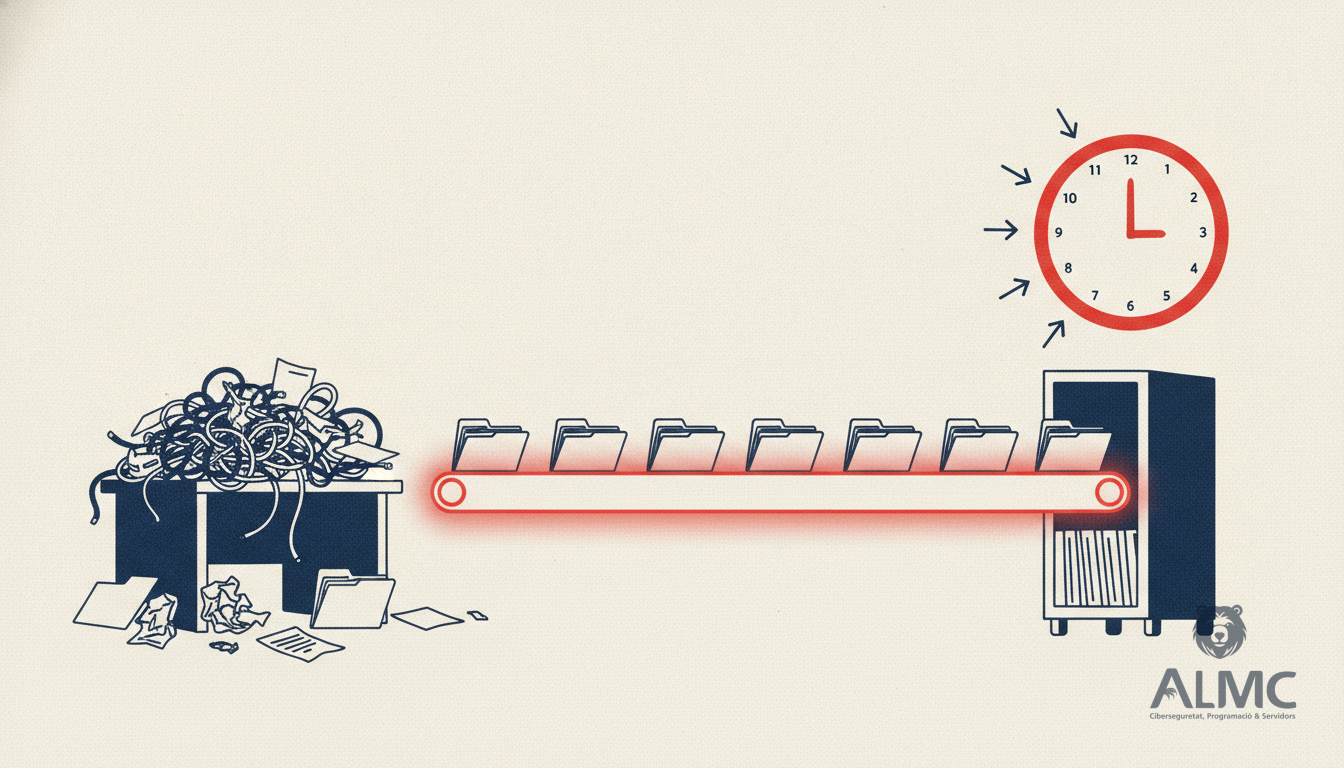
The hidden cost is not the licence fee. It is the hours lost to searching, re-keying and correcting avoidable mistakes. Industry surveys repeatedly show that a large share of companies do not obtain the return they expected from their business software, and that complexity is a leading cause of employee frustration. You do not need more applications. You need the ones you already pay for to talk to each other.
The tell-tale signs your team is working around the system
When tools are hard to use, people improvise. That improvisation is usually rational, not resistance to change. Watch for these behaviours:
- Staff keep local copies of documents because finding the official version takes too long.
- Personal spreadsheets appear to fill gaps the software should cover.
- Files are sent by email because the official sharing workflow is cumbersome.
- Colleagues ask each other for data the system ought to display by itself.
- Unofficial processes exist that everyone knows but no system supports.
Each workaround is a small leak. Multiplied across a team, it becomes a serious drain on capacity, morale and revenue. The fix is rarely a bigger platform; it is connecting the pieces you have so the path from task to completion gets shorter.
What process automation actually looks like in an SME
Automation is often imagined as something for large corporations with dedicated IT departments. In practice, the biggest wins for a small or medium business come from modest, well-chosen workflows. Think of the repetitive steps that happen every week without fail: a form submission that must be copied into the CRM, an invoice that needs filing, a new order that should trigger a stock check and a confirmation email.
With a workflow tool such as n8n, those steps can be chained together. When a trigger fires, the system moves the data, updates the records and notifies the right person. No one has to remember, and no one has to re-type. The integrations do the boring part so your team can do the valuable part.
Five automations that pay for themselves quickly
- Lead capture to CRM: website forms, WhatsApp enquiries and phone notes flow into a single customer record, with an owner assigned automatically.
- Invoice and document handling: incoming invoices are read, categorised and filed in the correct folder, ready for your accounting review.
- Order and stock alerts: when stock drops below a threshold, a purchase suggestion reaches the responsible person before a customer notices.
- Onboarding sequences: a new hire triggers account creation, document requests and a welcome message, all tracked in one place.
- Weekly reporting: figures from sales, support and finance are gathered and delivered as a summary every Monday morning, without anyone assembling it by hand.
None of these requires replacing your existing software. They require integration, which is precisely where a specialist agency adds value.
Easy to use is no longer optional
Employees compare business tools with the apps they use in their personal lives. If a routine task needs a training video or a support ticket, the tool is already losing. Usability today means being available when needed, accessible from wherever work happens, and shortening the distance between starting a task and finishing it.
Mobile matters here too. People are not glued to a desk all day. The best mobile experiences focus on essentials: checking a status, approving a request, opening a document. Automation supports this by removing the steps that never needed a human in the first place.
Getting started without disrupting the business
A sensible approach is to map the processes that consume the most time, rank them by frequency and frustration, and automate the top two or three first. Measure the hours saved before expanding. Keep data protection in mind from day one: under GDPR, any workflow that moves personal data needs a clear legal basis, sensible access controls and a record of what happens to that data. Automation makes compliance easier to evidence, not harder, provided it is designed with care.
For SMEs across Catalonia, the goal is not to look modern. It is to reclaim the hours that repetitive administration steals every week. That is the productivity gain worth pursuing, and it starts with connecting the tools you already own.
Related
- n8n Automation Guide: Streamline Your Business Workflows in 2026
- How Much Does Process Automation Really Cost? A 2026 Guide for SMEs
- Best WordPress SEO Plugins 2026: Expert Comparison for Spanish Sites
- Chatbot IA
Put these ideas into practice
Talk to ALMC about a solution for your business. Explore your options or contact our team.