
Blog
Document Custody and Automation: Keeping Your SME's Files Under Control
Why document custody matters more than most SMEs thinkMost small businesses believe they know exactly where every contract, invoice and commercial rec...
Why document custody matters more than most SMEs think
Most small businesses believe they know exactly where every contract, invoice and commercial record lives. Then a client asks for a signed agreement from three years ago, an auditor requests a specific delivery note, or a supplier disputes a payment, and suddenly nobody can say which shared folder holds the right version. Document custody is the discipline that prevents this situation: it means conserving, archiving and protecting documents for as long as they are needed, so that they stay intact, legible and available to the people authorised to consult them.
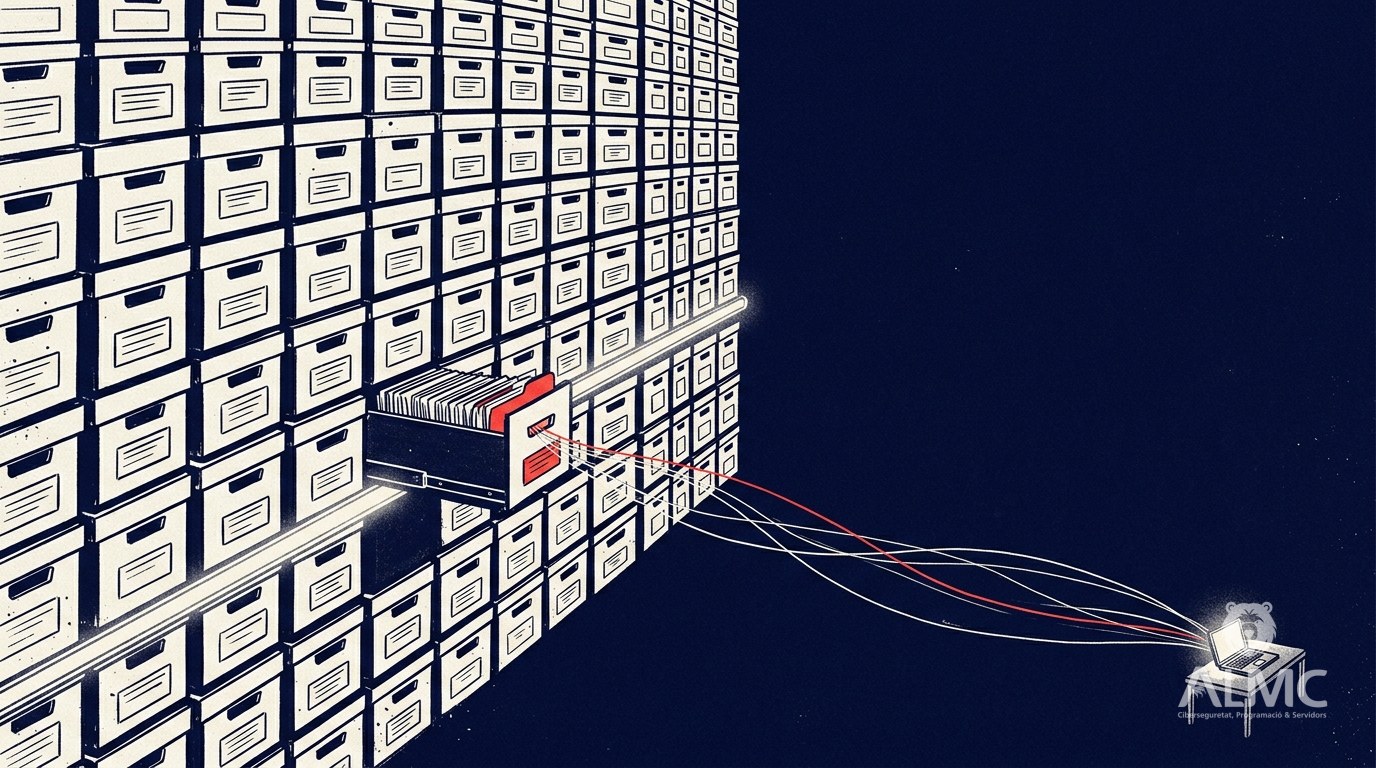
Custody is not simply storing a box in a warehouse or dropping files into a drive. It also requires knowing which documents exist, where each one is located, who may access it and when it should be retained or securely destroyed. When that knowledge is lost, the consequences are operational, financial and legal at the same time.
Physical, digital and hybrid custody
Custody can cover paper originals, electronic files or a combination of both, and each model demands different controls:
- Physical custody: paper originals kept in facilities with access control, surveillance, humidity monitoring and fire protection. Space, deterioration and mishandling are the main risks.
- Digital custody: files stored in electronic systems with permissions, integrity checks, backups and recovery options. Order is essential; a shared folder without clear criteria simply moves the chaos from the filing cabinet to the screen.
- Hybrid custody: the most common scenario in Catalan SMEs, where paper originals are retained while scanned copies are used for daily work. The key is keeping a clear link between the original and its digital version.
In all three cases, the underlying question is the same: can you find the right document, in the right version, for the right person, at the right moment?
How custody works across the document lifecycle
Custody begins the moment a document is created or received and continues for as long as it must be kept. A practical process usually follows a few clear steps:
- Reception and classification: identify the type of document, its origin and the business process it belongs to. A contract links to a client or supplier; an invoice links to a financial year.
- Registration and indexing: assign consistent metadata so the document can be retrieved by reference, date, counterparty or project rather than by memory.
- Access control: define who can view, edit or approve each document, particularly when it contains personal data.
- Retention and disposal: set retention periods according to Spanish commercial and tax obligations, and apply secure deletion once they expire.
When these steps depend on people remembering to do them, they eventually break down. That is where automation changes the picture.
Where process automation fits in
Automation does not replace good document custody policy; it enforces it consistently. Instead of relying on someone to rename a file, move it to the correct folder and notify the right colleague, you build workflows that do it every time, without exceptions.
At ALMC, working with SMEs across Lleida, Barcelona, Tarragona and Girona, we connect the tools companies already use, such as email, cloud storage, invoicing software and CRM systems, and orchestrate them with platforms like n8n. The result is a set of integrations and workflows that save hours every week and, more importantly, remove the human gaps where documents get lost.
Typical examples include:
- An invoice arrives by email and is automatically classified, renamed, stored in the correct folder and logged in the accounting system.
- A signed contract triggers a workflow that archives the final version, notifies the account manager and schedules a renewal reminder.
- A new supplier is registered and their documentation is requested, validated and filed without manual follow-up.
- Retention rules run in the background, flagging documents that are due for review or secure deletion.
GDPR and Spanish retention obligations
Document custody is also a compliance matter. Under the GDPR, personal data must be processed lawfully, kept accurate and retained no longer than necessary. Spanish commercial and tax rules impose their own retention periods, and an SME must be able to demonstrate, if asked, what it holds, why and for how long. Automated custody helps here too: access logs, consistent metadata and scheduled reviews make it far easier to answer a data subject request or an inspection without a frantic search through shared drives.
Getting started without a big project
You do not need to redesign your entire archive at once. Start with the document type that causes the most friction, such as supplier invoices or client contracts, map how it currently moves through your business, and automate the most repetitive steps first. A modest, well-designed workflow that saves a few hours a week is a far better starting point than an ambitious plan that never leaves the drawing board.
If your team spends time hunting for files, renaming documents or chasing approvals by email, automated document custody is one of the most direct ways to gain productivity. It turns a fragile, memory-based system into a reliable process that works quietly in the background.
Related
- n8n Automation Guide: Streamline Your Business Workflows in 2026
- How Much Does Process Automation Really Cost? A 2026 Guide for SMEs
- Best WordPress SEO Plugins 2026: Expert Comparison for Spanish Sites
- Chatbot IA
Put these ideas into practice
Talk to ALMC about a solution for your business. Explore your options or contact our team.