
Abuse Shield: Centralised Server Security for Catalan SMEs
Abuse Shield: Centralised Server Security for Catalan SMEs
Why scattered server defences quietly failMost small and mid-sized organisations in Catalonia do not run one server; they run five, ten, or twenty. A...
Why scattered server defences quietly fail
Most small and mid-sized organisations in Catalonia do not run one server; they run five, ten, or twenty. A web front end in Barcelona, a database in Lleida, a mail relay in Girona, a staging box in Tarragona. Each one accumulates its own firewall rules, its own fail2ban jails, its own logs. And each one learns about attacks in isolation. When an IP hammers your mail server on Monday, your web server knows nothing about it on Tuesday. That gap is exactly what attackers exploit.
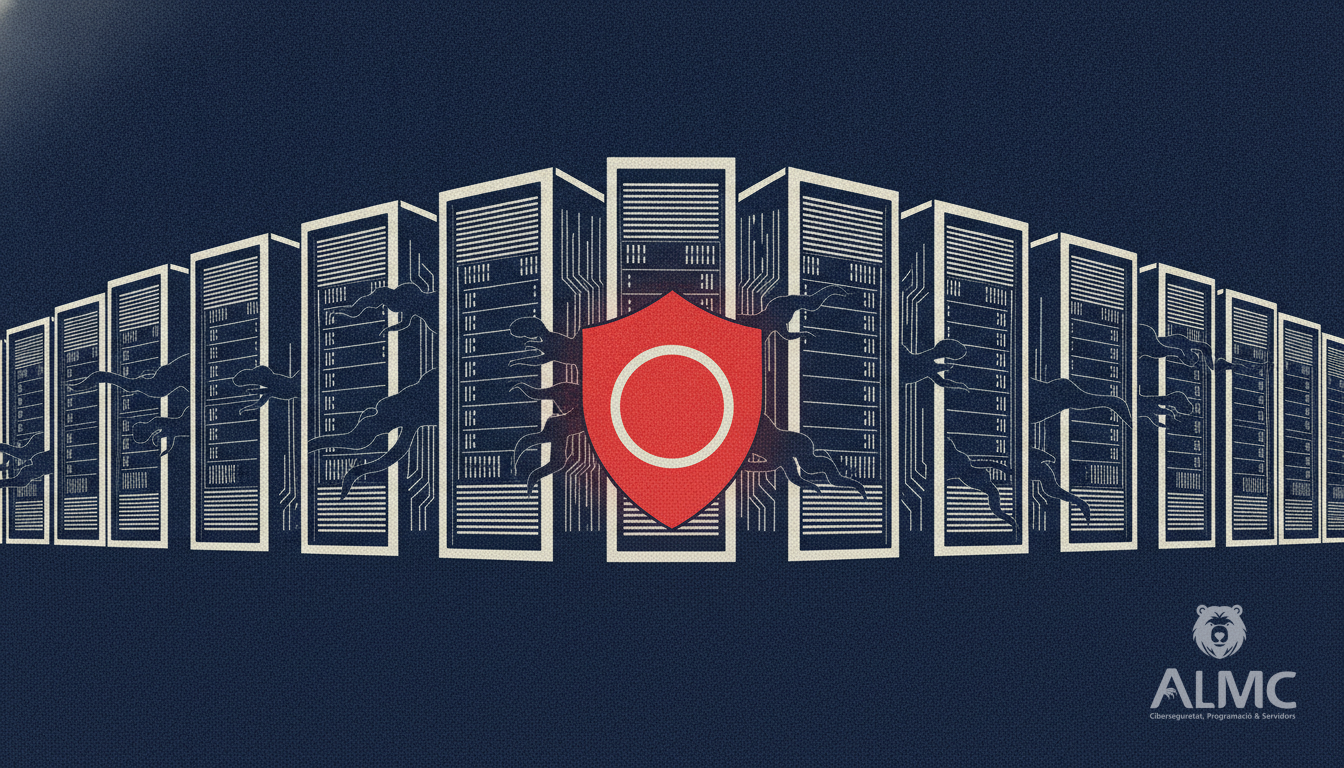
The threat landscape reinforces the point. Recent telemetry from large-scale monitoring shows that social engineering and malicious downloaders now run neck and neck as the most common attack vectors, together accounting for a large share of all alerts. Exploit activity is still dominated by vulnerabilities disclosed years ago that were never patched. In other words, the attacks are not exotic. They are repetitive, automated, and they probe every exposed service you own. A fragmented defence gives them repeated chances to succeed.
What Abuse Shield actually does
Abuse Shield is ALMC's managed protection layer for server fleets. Instead of installing and tuning fail2ban by hand on every machine, you connect your servers to a single control plane that does the heavy lifting:
- Automatic IP blocking. Malicious IPs are identified and blocked without waiting for an administrator to read logs at midnight. Rules are applied consistently across every connected machine.
- Managed fail2ban at fleet scale. Jails, thresholds and ban durations are configured once and rolled out everywhere, so a new server inherits the same protection as the rest from day one.
- A shared reputation feed. When one server detects abuse, every other server in your fleet learns about it. An IP banned on the mail relay is already blocked on the web front end before it tries.
The effect is cumulative. Each machine becomes a sensor for the others, and the cost of defending the tenth server is far lower than the cost of defending the first.
Built for the way Catalan SMEs actually work
Hosting providers in Barcelona and sysadmins managing infrastructure for clients across Lleida, Tarragona and Girona face a common problem: they are accountable for security but do not have a dedicated SOC. Abuse Shield is designed for that reality. It reduces the operational load of server security to a dashboard and a set of policies, while keeping the underlying mechanics transparent enough for a competent administrator to audit.
It also fits neatly alongside GDPR obligations. Article 32 requires appropriate technical measures to protect personal data, and demonstrable, centrally managed access controls and intrusion prevention are exactly the kind of evidence a data protection audit looks for. When a client asks how their data is protected, you can show a unified policy rather than a patchwork of per-machine configurations.
Where the real risk sits today
Two patterns deserve attention. First, phishing and QR-based deception have become mainstream entry points, often bypassing traditional email inspection. Second, unpatched legacy vulnerabilities in productivity suites remain heavily exploited, long after fixes were published. Neither threat is stopped by a single firewall rule. But both produce the same observable symptom: a burst of requests from IP addresses that have no business talking to your servers.
That is where a shared reputation feed earns its keep. The moment one of your machines sees the pattern, the whole fleet reacts. You do not need to predict the next campaign; you need your infrastructure to remember every previous one.
Practical rollout
Adoption is incremental. Start with the internet-facing servers that generate the most noise, typically web and mail. Let the reputation feed populate for a couple of weeks while you review the blocks in audit mode. Then enable enforcement fleet-wide and move on to internal services. Most teams reach a stable configuration within a month, with the ongoing effort limited to reviewing alerts that matter rather than tailing logs on every host.
Security does not improve by adding more tools. It improves by making the tools you already trust work together. Abuse Shield is the layer that turns a collection of individually defended servers into a single, coordinated defence.
Related
- How to Harden Your Servers with Fail2ban and IP Reputation Feeds
- Fail2ban: Your First Line of Defense Against Unauthorized Server Access
- Critical libssh2 flaw: urgent patch for SSH servers
- Desarrollo web
Put these ideas into practice
Talk to ALMC about a solution for your business. Explore your options or contact our team.