
Server Security Beyond Phishing: Blocking Malicious IPs at the Edge
Server Security Beyond Phishing: Blocking Malicious IPs at the Edge
Phishing has changed, and your perimeter should tooFor years, security awareness training relied on a handful of visible tells: clumsy grammar, an odd...
Phishing has changed, and your perimeter should too
For years, security awareness training relied on a handful of visible tells: clumsy grammar, an odd sender address, a login page that looked slightly off. Those tells still matter, but their absence no longer proves anything. Modern social engineering campaigns are polished, culturally adapted and timed to land in the middle of a normal working day, when the recipient is already authenticated and a request for action feels routine. Attackers have moved from stealing passwords to stealing session tokens, and ready-made phishing kits are now sold as a service, so even low-skilled actors can launch convincing campaigns.
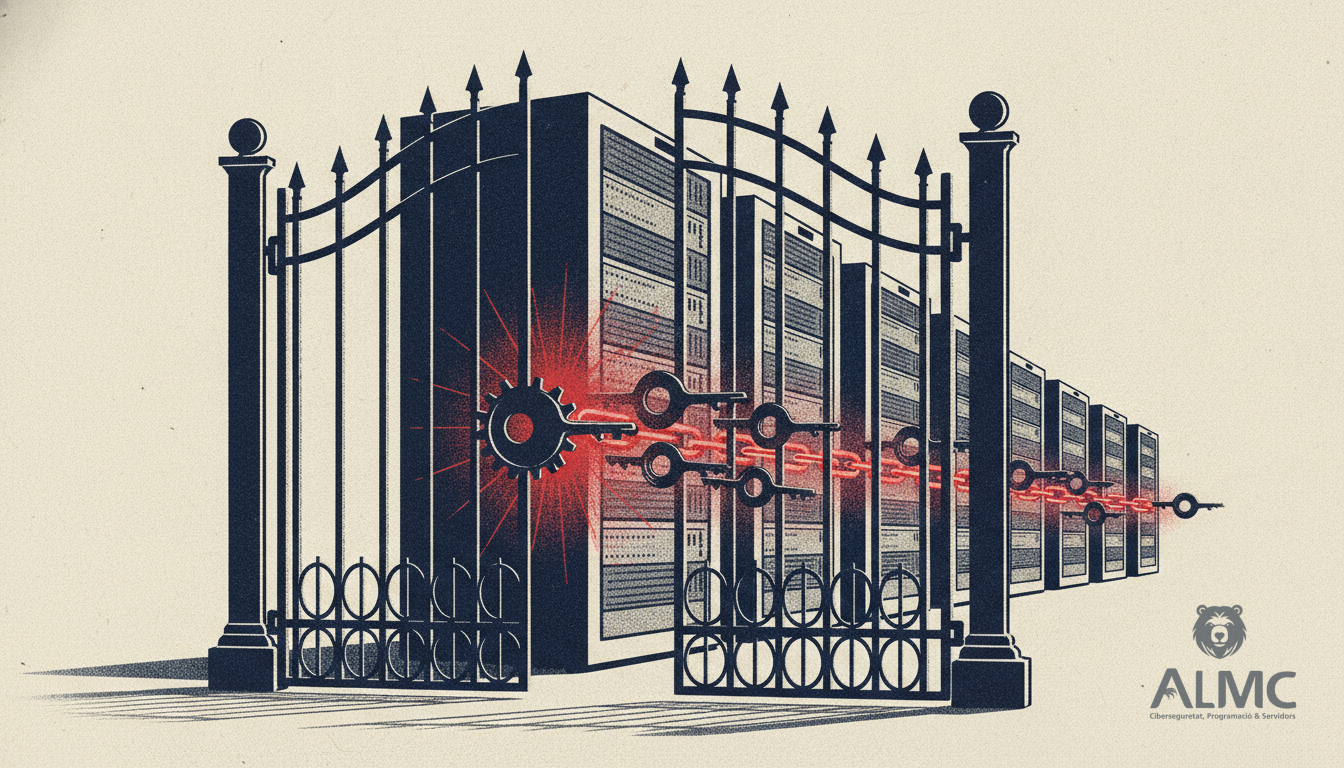
For system administrators, hosting providers and small businesses running their own servers in Barcelona, Lleida, Tarragona or Girona, this shift has a direct consequence. If a single employee can be tricked into handing over an active session, the question is no longer only how to stop the email. It is how quickly you can contain what happens next, and how well your infrastructure resists the automated scanning and brute-force attempts that follow every successful compromise.
Where the real damage happens: the server layer
Most phishing coverage focuses on the inbox, but the practical fallout lands on your machines. Once credentials or tokens leak, attackers and botnets test them against SSH, mail services, control panels and web applications. These attempts are rarely manual. They arrive as distributed, low-and-slow probes from hundreds of addresses, which is exactly the pattern that overwhelms a reactive, machine-by-machine approach.
The typical response in a small IT team looks like this:
- Fail2ban is installed on one server, half-configured on a second, and forgotten on a third.
- Each machine keeps its own ban list, so an IP blocked on the web server is still free to hammer the mail server.
- Nobody has time to review logs, so rules are either too aggressive or never triggered.
- When a new virtual machine is deployed, hardening is copied from an old template nobody trusts.
This fragmentation is the real weakness. An attacker only needs one unprotected entry point, and your protection is only as strong as your least-maintained machine.
Centralised protection with Abuse Shield
Abuse Shield is built around a simple idea: treat protection as one system, not as a collection of isolated servers. It centralises the management of fail2ban across multiple machines, so bans, thresholds and rules are defined once and applied consistently everywhere. When a malicious address is detected on any of your servers, the block propagates automatically instead of waiting for each machine to rediscover the same attacker.
The second pillar is a shared IP reputation feed. Addresses observed attacking one server are pooled and distributed across the whole fleet, which means your infrastructure learns from every incident at once. A botnet that probes a staging server in Lleida is blocked on the production cluster in Barcelona before it gets a second attempt. For hosting companies managing dozens or hundreds of instances, this turns scattered telemetry into a genuine defensive asset.
In practice, this covers the fundamentals that matter most:
- Automatic blocking of malicious IPs based on real behaviour, without manual log review.
- Managed fail2ban across all your machines, with consistent configuration and no drift.
- Shared reputation so that a threat seen once is neutralised everywhere.
- Less operational overhead for teams that cannot dedicate a full-time analyst to server hardening.
Fitting it into a GDPR-aware stack
Any tool that processes connection data and IP addresses touches personal data under the GDPR, and Spanish organisations should treat this seriously. Abuse Shield is designed to work within that framework: IP addresses are processed for the legitimate purpose of security and fraud prevention, retention is kept proportionate, and access to the platform is restricted to the administrators who need it. Documenting this processing in your records of activities, and mentioning it in your security policy, is a small effort that pays off during audits and client due diligence, especially if you are a hosting provider serving EU customers.
It also complements, rather than replaces, the human layer. Awareness training still has value, but it should be treated as one control among several. Assume that someone will eventually click, and design your servers so that the click does not become an incident.
A pragmatic starting point
You do not need to rebuild your infrastructure overnight. Start by inventorying every machine that accepts inbound connections, including the ones everyone forgets: backup nodes, staging environments, monitoring hosts. Then unify their protection under a single management layer, define sensible thresholds, and let the shared reputation feed do the repetitive work. Review the results after a few weeks; most teams find that the volume of noise drops sharply and that genuine incidents become far easier to spot.
Phishing will keep evolving, and no single measure will stop it. But a server fleet that blocks malicious IPs automatically, learns from every machine and stays consistently configured gives you something far more valuable than a perfect inbox filter: time to react when something does get through.
Related
- How to Harden Your Servers with Fail2ban and IP Reputation Feeds
- Fail2ban: Your First Line of Defense Against Unauthorized Server Access
- Critical libssh2 flaw: urgent patch for SSH servers
- Desarrollo web
Put these ideas into practice
Talk to ALMC about a solution for your business. Explore your options or contact our team.